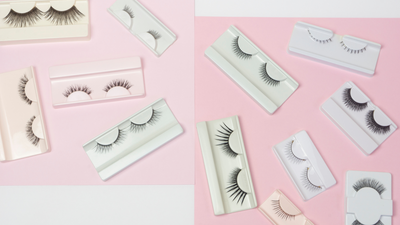





Best False Lashes for Older Women: What Actually Changes, and What to Wear

Age is not the reason false lashes stop working. Four specific physical changes are, and each one has a different answer. Once you know which of them applies to you, the choice narrows to two or three styles very quickly. Nothing here is about looking younger. It is about the lash fitting the eye you have now.
- The sweet spot is 8mm to 11mm. Long enough to stay visible if your lid has started to hood, short enough not to brush your glasses or weigh a softer lid down.
- Go lighter on colour before you go shorter on length. Dense black is what reads as heavy on a mature face, not the lash itself. Our brown range solves it in one step.
- Skip strip glue entirely. Peeling a glued band off thinner lid skin takes natural lashes with it, and those are slower to grow back than they used to be.
- Magnetic forgives shaky hands. There is no drying clock, and you can lift and reposition the lash as many times as you need without ruining it.
- Best everyday pick: Lucinda, 5mm to 10mm, round, glasses compatible, and made in brown as well as black.
- If your lashes are sparse, a clear or invisible band hides the gaps far better than a solid black one.

The four things that actually change
Most advice written for older women is about what is flattering, which is another way of saying somebody's taste. This article is about mechanics. Four things change with age, they change at different rates in different people, and each one points at a different lash.
| The change | What it does to a lash | What to choose instead |
|---|---|---|
| The lid starts to hood | The fold sits in front of your lash line and hides short fibres behind it | Length with a high minimum, 8mm and up |
| Natural lashes thin and lighten | A solid black band has nothing to blend into, so it reads as pasted on | A clear or invisible band, or brown fibre |
| Lid skin becomes thinner and drier | Glue and peeling take lashes and irritate skin, and liner sits unevenly on crepey skin | No glue, thin flexible bands, clear liner |
| Close vision and steadiness change | You are applying a lash you cannot see clearly, against a drying clock | Magnetic, which is repositionable and never sets |
1. If your lid has started to hood
This is the most common of the four and the one people least expect. Hooding, which clinicians call dermatochalasis, is loose upper eyelid skin folding down over the mobile lid. Onset is most often noted in the forties and it progresses with each decade, with more than half of adults past 60 showing it to some degree.1 It is not a sign that anything is wrong. It is simply the most common structural change to the eyelid there is.
It matters for lashes because the fold sits in front of your lash line, so any fibre shorter than the depth of the fold is hidden behind it. This catches people out, because the instinct with age is to go shorter and subtler, and shorter is exactly the wrong direction here. If you have felt that lashes "do nothing" on you now when they used to work, this is almost always why.
The full mechanics are in our guide to false lashes for hooded eyes. For everyday wear the styles that clear a mild to moderate fold without going dramatic are Elsa (8mm to 11mm), Jasmine (8mm to 10mm) and Humble (8mm to 11mm), all three of which are also glasses compatible.
2. If your natural lashes have thinned
Lashes get finer and sparser over time, and they lose pigment the same way hair does. The visible consequence is that a dense black band has nothing to blend into. On a full natural lash line the band disappears into your own lashes. On a sparse one, it sits above a gap and the eye reads it as a separate object stuck to your lid.
There are two fixes and they work in different ways.
- Take the black out of the band. Our Crystal Clear band range uses a transparent band with a clear adhesive liner, so there is no dark line to sit above a gap. Humble at 8mm to 11mm is the pick if your lid has also softened. The Invisible Magnets range does something similar with a fine fully magnetic band and no visible magnet blocks.
- Take the black out of the fibre. Brown fibre reads as a softer lash line and is far more forgiving against lighter or greying natural lashes. Merida is our softest at 4mm to 9mm, and both Lucinda and Ariel are made in brown as well as black.
3. If your lid skin has become thinner or drier
This is the change that makes traditional strip lashes a poor idea, and it is worth being blunt about. Strip lash glue bonds to the skin of your lid. Peeling that off thinner skin is uncomfortable, it can take natural lashes with it, and those lashes are slower to return than they were twenty years ago. Repeated over months it is a losing trade.
Every Youthphoria lash avoids that entirely. Magnetic styles hold to a magnetic liner rather than to your skin, Crystal Clear bands hold to a clear adhesive liner that lifts off without pulling, and Fastbond press-on clusters bond lash to lash under your own lashes so nothing touches the lid at all. Removal is a lift, not a peel.
The second consequence is about liner. Crepey lid skin does not take a smooth line of black liquid liner the way taut skin does, and a wobbly black line draws more attention than the lash. A clear adhesive liner sidesteps the problem completely, because an uneven line of something invisible is still invisible. For many of our older customers this single change is what made lashes wearable again.
4. If application has become the hard part
This is the one almost nobody writes about, and in the salon it is the most common reason people have given up. You are applying a small object to your own eye, usually without the glasses you need to see it, sometimes with hands that are less steady than they were. Traditional lashes make that worse by adding a timer: the glue is drying while you work, so a misplaced lash is a ruined lash.
Magnetic removes the timer. The lash snaps to the liner, and if it lands crooked you lift it off and place it again, as many times as you like, with no damage and no mess. Nothing sets. That is a genuine accessibility advantage, not a marketing line.
Real review: Rachel, 54, wears Lucinda
Rachel is 54 and wasn't sure false lashes were for her. She bought magnetic lashes from four Australian brands and chose Youthphoria because they were the lightest. She wears Lucinda, the natural style we suggest starting with.
That is what most women over 50 tell us they want: natural looking false lashes that look, feel and move like real lashes. Soft, fluttery and believable up close, never heavy, glossy or spiky, so they open up mature eyes without looking overdone. Magnetic lashes suit women at any age, with no glue on the lid.
The picks


Lucinda
5mm to 10mm round natural volume on a 33mm band, glasses compatible, and made in brown as well as black. Believable at close range, which is where it will be seen. The one to start with.
Shop Lucinda

Elsa
8mm to 11mm wispy round on a 34mm band, glasses compatible. The highest minimum length of the soft natural styles, so it stays visible if your lid has started to hood.
Shop Elsa

Merida
4mm to 9mm in soft brown, wispy and round with a slight flare. The gentlest lash line we make. Choose this if black has started to look severe on you.
Shop Merida

Humble
8mm to 11mm on a 30mm Crystal Clear band with clear adhesive liner. No black band, no black line, nothing to sit unevenly on softer lid skin. Glasses compatible.
Shop Humble

Jasmine
8mm to 10mm round, glasses compatible. The most understated style in the range that still has a high enough minimum length to clear a mild fold. Quietly effective.
Shop Jasmine

Pocahontas
6mm to 11mm round doll-eye in full Russian volume, glasses compatible. The occasion lash that adds height through the centre of the eye without adding length you will feel.
Shop PocahontasSpecifications side by side
| Style | Length | Band | Band width | Colour | Glasses |
|---|---|---|---|---|---|
| Lucinda | 5 to 10mm | 6 micro-magnets | 33mm | Black or brown | Yes |
| Elsa | 8 to 11mm | 6 micro-magnets | 34mm | Black | Yes |
| Jasmine | 8 to 10mm | 6 micro-magnets | 33mm | Black | Yes |
| Merida | 4 to 9mm | 6 micro-magnets | 34mm | Brown | Yes |
| Serena | 5 to 9mm | 6 micro-magnets | 32mm | Black or brown | Yes |
| Humble | 8 to 11mm | Crystal Clear | 30mm | Clear band | Yes |
| Modest | 7 to 10mm | Crystal Clear | 27mm | Clear band | Yes |
| Pocahontas | 6 to 11mm | 6 micro-magnets | 33mm | Black | Yes |

What to leave alone
- Traditional strip lashes and lash glue, for the skin and natural lash reasons above. This is the only item on this page we would call a firm no.
- Extra long styles for everyday. Astral (7mm to 15mm), Mystic (9mm to 14.5mm) and Divine (8mm to 14.5mm) are lovely for an event, and all three are marked not glasses compatible because the tips will brush a lens.
- Heavy mega volume on a 34mm band as a daily lash. Tiana and Tiger Lily are occasion lashes. A softer lid feels weight sooner than a taut one does.
- Going shorter to compensate for hooding. The most common mistake, and it makes the problem worse rather than better.
If you wear glasses
Most of the range's longer styles are marked not glasses compatible, because fibres past about 11mm brush the lens and smudge it. Every style in the picks above is glasses compatible, which is not a coincidence: 11mm is the practical ceiling, and it happens to sit right at the top of the range that suits a softening lid. Our full glasses compatible collection and the guide to wearing lashes with glasses cover the rest.
Frequently asked questions
What are the best false lashes for older women?
The best false lashes for older women sit between 8mm and 11mm, use a thin flexible band, and avoid glue. Length in that range stays visible if the lid has started to hood while staying short enough not to brush glasses or weigh a softer lid down. Lucinda, Elsa, Jasmine and Humble all meet those criteria and are glasses compatible. If black has started to look severe, Merida in brown is the softest option.
Are false eyelashes suitable after 50, 60 or 70?
Yes. Age itself is not a limit. What changes is the eyelid, not the eligibility. Four things matter: whether the lid has begun to hood, whether your natural lashes have thinned, whether the lid skin has become thinner, and whether application has become physically harder. Each has a specific answer, and magnetic and clear band systems address all four better than traditional glue-on strips do.
What are the most natural looking false lashes for mature eyes?
Soft, round styles between about 5mm and 11mm on a thin band look the most natural on mature eyes, because they add definition without weight. Choose lashes that look, feel and move like real lashes rather than heavy, glossy strips. Lucinda is the one to start with: Rachel, 54, wears it in her video review above. If black looks severe on you, Merida in brown is the softest option.
Do false lashes damage thinning natural lashes?
Glue-on strip lashes can, because the adhesive bonds to the lid and lashes and peeling it away takes some of them with it. Magnetic lashes hold to a magnetic liner rather than to your lashes, and Crystal Clear bands hold to a clear adhesive liner that lifts off without pulling. Neither is peeled off the skin, so neither takes natural lashes with it.
Which false lashes are easiest to apply with shaky hands or poor close vision?
Magnetic, without question. There is no drying time, so nothing is ruined if you take a while, and a lash that lands crooked lifts straight off and goes on again. Use a magnifying mirror placed below your eye line, brace the heel of your hand on your cheekbone, and use a lash applicator tweezer rather than fingers. Cluster press-ons take a little more patience at first, so most people start with a magnetic band and try them once they have their eye in.
Should older women wear black or brown lashes?
Brown is worth trying if black has started to look severe on you, which usually happens as natural lashes lose pigment and the contrast against the skin increases. Brown reads as a softer lash line at close range while still defining the eye. Merida is the softest, and Lucinda, Ariel and Serena are each made in brown as well as black.
My lashes look like they do nothing now. Why?
Usually hooding. As upper lid skin softens it folds forward over the lash line, and any fibre shorter than that fold is hidden behind it. The instinctive response is to buy something even more subtle, which makes it worse. Move to a style whose shortest fibre is 8mm or more, such as Elsa, Jasmine or Humble, and check it in the mirror looking straight ahead rather than looking down.
How long do these lashes last?
Youthphoria magnetic and clear band lashes are reusable for 30+ wears when cleaned and stored in their case after each use. That works out cheaper per wear than disposable strips, and there is no glue to keep buying.
Not sure where to start?
Take the lash finder, or have Shirley look at your actual eyes and lashes in person in Melbourne.
Related reading
- The complete guide to choosing false lashes
- Best false lashes for hooded eyes
- Glasses compatible magnetic eyelashes
- Why brown lashes read softer than black
- Thin band and lightweight false lashes
- Lashes for sensitive eyes and glue allergy
- Medscape. Dermatochalasis: Background, Pathophysiology, Epidemiology. emedicine.medscape.com. Notes onset most often in the fourth decade, progression with each decade, and more than half of adults past 60 affected to some degree.
- American Academy of Ophthalmology. Dermatochalasis. EyeWiki. Defines dermatochalasis as redundant upper eyelid skin with the eyelid margin in normal position.
This article is general cosmetic guidance about eyelid changes and false lash fit. It is not medical advice and does not diagnose or treat any condition. If your eyelids are affecting your field of vision, or you have pain, redness, irritation or sudden lash loss, speak to your optometrist or GP.